


- Define social and emotional competence.
- Identify strategies to promote social and emotional competence in children.
- Use strategies that promote social and emotional competence in all children.
Learn
Know
Secure Attachments
Social and emotional development begins at birth. During the first six months of life, infants learn how to communicate so caregivers will respond to their needs. The back-and-forth interaction between children and adults forms attachment. In secure attachments, children feel safe and protected—especially when they are ill, scared, or experiencing changes. There are different qualities of attachment, and the quality of attachment depends on how responsive adults are to children’s needs. Adults who respond quickly and warmly to a crying infant, stressed preschooler, or upset youth build secure attachments over time. Adults who ignore children’s communication, respond negatively, and have difficulty reading children’s cues face more difficulty forming secure attachments. Secure attachment sets the stage for later social and emotional growth. Children with a history of secure attachments cry less as infants and toddlers, are better able to bounce back from every day challenges, and respond to support from others. This helps children learn to be effective communicators and creates a foundation for children’s and youth’s continued development throughout life.
Social and Emotional Development
A primary responsibility of direct care staff in child care programs is to support the social and emotional competence of children and youth. You may have heard this term before, but do you know what social and emotional learning (SEL) means?
Social and emotional learning is the process through which children and adults understand and manage emotions, set and achieve positive goals, feel and show empathy for others, establish and maintain positive relationships, and make responsible decisions.
—Collaborative for Academic, Social, and Emotional Learning (CASEL)
The CASEL framework identifies five core competencies that make up social and emotional learning (SEL):
Self-awareness:
The ability to accurately recognize one’s emotions, thoughts, and their influence on behavior. This includes accurately assessing one’s strengths and limitations and possessing a well-grounded sense of confidence and optimism.
Self-management:
The ability to control one’s emotions, thoughts, and behaviors effectively in different situations. This includes managing stress, controlling impulses, motivating oneself, and setting and working toward personal and academic goals.
Social awareness:
The ability to take the perspective of and empathize with others from different backgrounds and experiences, to understand social norms for behavior, and to recognize family, school and community resources and supports.
Relationship skills:
The ability to establish and maintain healthy and rewarding relationships with various individuals and groups. This includes clear communication, active listening, cooperation, avoiding social pressure, conflict resolution, and obtaining or providing help when needed.
Responsible decision-making:
The ability to make constructive and respectful choices about personal behavior and social interactions. This includes consideration of ethical standards, safety concerns, social norms, the realistic evaluation of consequences of various actions, and the well-being of self and others.
Child abuse and neglect can happen to anyone, however there are some factors that put children at a higher risk for child abuse and neglect. Children with challenging behavior are often missing critical social emotional skills that allow that allow them to interact and communicate their needs in positive ways. Children who exhibit challenging behavior and lack the skills listed in the CASEL framework are at a higher risk for being abused by parents or caregivers. For example, a child who is frequently unable to control their impulses can increase the amount of stress that a family is experiencing. If the child’s family is experiencing stress and lacks the resources to help manage their stress, this could lead to harsh discipline or abuse. While abuse is never the fault of the child, teaching children social and emotional skills can help them avoid abuse from negative behavior. Children who have intentional social and emotional learning opportunities are more likely to advocate for themselves, ask for help, express their emotions in prosocial ways, manage anger, prevent violence, and connect with others. By providing excellent care to children in your program and teaching them these skills, they may avoid future abuse for negative behavior.
Social emotional competence also supports skill development in other areas of learning such as cognitive, physical, and language development. According to the Center for the Study of Social Policy, children who are socially and emotionally competent have:
- Healthy self-esteem
- Self-confidence
- Self-efficacy (belief in their ability to do things)
- Self-control
- Personal agency
- Patience
- Persistence
- Conflict-resolution skills
- Communication skills
- Empathy
- Social skills
- Morality
All child care staff can positively influence how parents and children interact and form relationships. Families notice how staff welcome children into the center, soothe fussy infants, calm disputes over toys, lessen tantrums, and respond to school-age children’s talk back. Direct care staff serve as models for how to promote social and emotional competence, and support staff have opportunities to do this in their work, too. What does this have to do with child abuse and neglect prevention in child care programs? When you view children from a social and emotional lens—understanding that children’s behavior communicates their thoughts, feelings, and ideas—you see more opportunities to initiate positive interactions. You are more likely to empathize with how children feel and understand the messages they communicate. For example:
- The crying infant is saying, “Comfort me.”
- The 9-month-old trying to climb the shelves is saying, “Help me explore.”
- The 3-year-old who is climbing up the slide is saying, “Help me learn to use this.”
- The toddler running around the room is saying, “Play with me.”
- The 4-year-old who is “tattling” on another child is saying, “We need your help.”
- The 9-year-old who tells you long stories about his favorite video game is saying, “Please pay attention to me.”
- The 11-year-old who throws a soccer ball over the fence after missing a goal is saying, “I’m frustrated.”
Understanding children’s behavior, such as in the examples above, helps you make more thoughtful decisions that promote positive interactions, through even the most difficult situations. These decisions strengthen your relationships with children, and supportive relationships help prevent child abuse and neglect.
Strategies to Support Social and Emotional Competence
There are key strategies that direct care staff use to promote social and emotional competence and prevent child abuse and neglect. Remember that all children, not just those with challenging behavior or those who are at risk, benefit from this support. Everyone can use these strategies, and it may be helpful to think of social and emotional support as a program-wide effort.
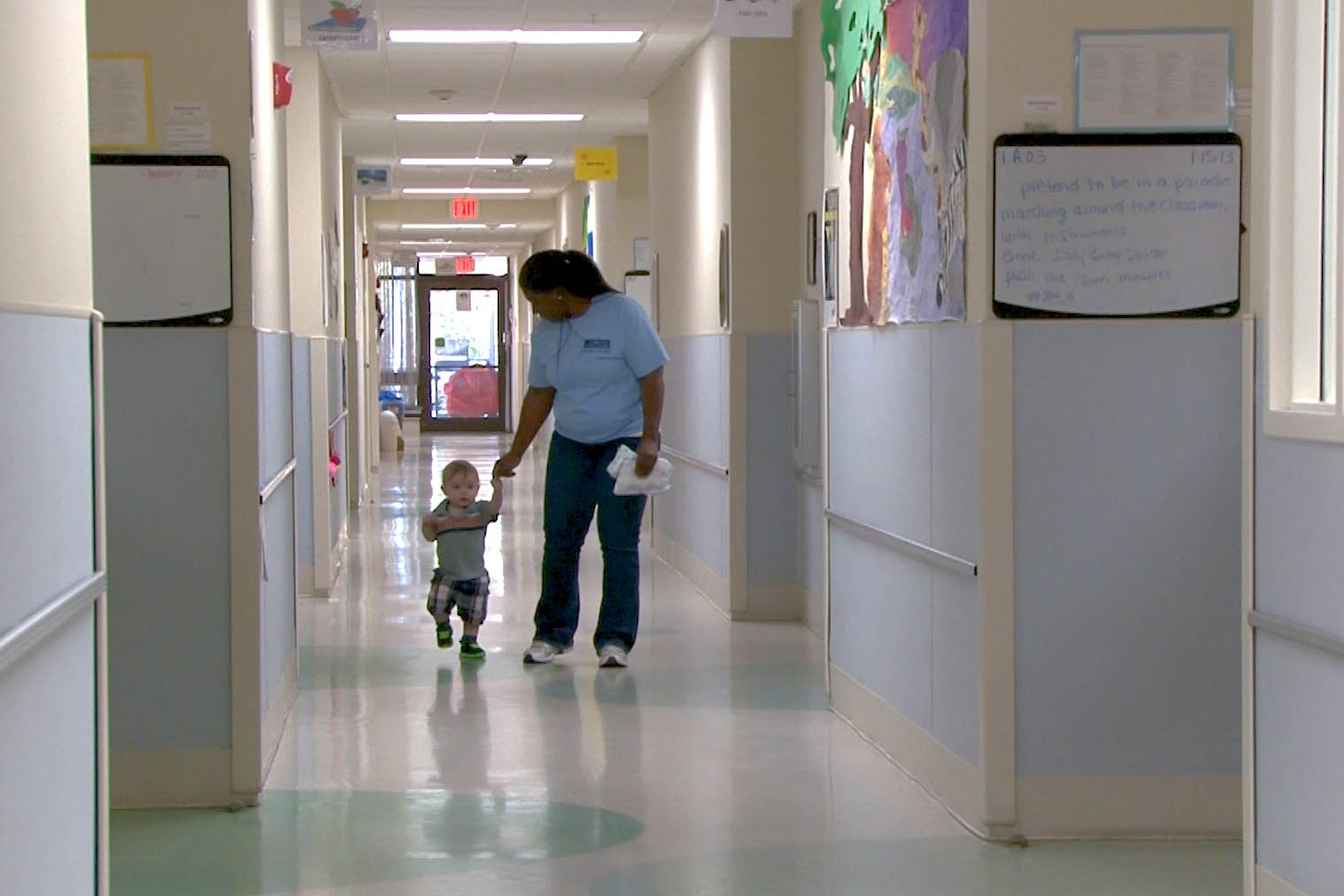

Nurturing and Responsive Relationships
Think back to the first section of this lesson where you read about how caregiver responsiveness creates secure attachments. Responsiveness is responding warmly, quickly, and accurately in ways that meet children’s needs or wants or acknowledge that they have communicated. Over time, continual nurturing helps children become more resilient, or better able to bounce back from challenges. Nurturing and responsive relationships build trust, affection, and confidence with exploring new ideas and activities. These are some of the ways that direct care professionals in your program develop nurturing and responsive relationships with children. Consider ways that you can use the following strategies in your role:
- Get down on the level of children and look them in the eyes when communicating.
- Observe children’s behavior and try to analyze or understand what it means.
- Use a calm, warm voice when speaking.
- Use and respond to nonverbal cues—facial expressions, tone of voice, and gestures.
- Acknowledge when children ask questions, make comments, or communicate they want your attention.
- Provide children with positive feedback. (“Thank you for waiting while I spoke to another grown-up. What can I help you with?”)
- Demonstrate curiosity about children and the things they do, say, and make. (“Tell me about the picture you painted.”)
Creating Supportive Environments and Routines
Children thrive in environments where they know what to do, when to do it, and how to do it. A thoughtful physical environment and routines that reflect children’s development will best promote social and emotional learning. Consider the classroom environments in your program and how direct care staff use these strategies:
- Develop routines that reflect children’s developmental abilities (limited sitting time and more active play for younger children).
- Arrange the environment so that it encourages positive behavior (e.g., minimize very wide-open spaces that encourage running).
- Use visual cues in the environment to remind children of expectations (e.g., posted schedules, written reminders of rules for school-age children).
- Provide enough toys and objects to support play and collaboration without being cluttered.
Talking about Feelings
Adults can talk about feelings with children during any activity or interaction. Whether you are monitoring the front desk, fixing a faucet, reading a book, or preparing breakfast, opportunities to discuss feelings naturally arise. Modeling how to label and talk about feelings promotes promotes your own emotional well-being, and minimizes stress—a risk factor for child abuse and neglect. Consider these ideas for talking about feelings:
- Talk about emotions throughout the day every day by labeling your own and others’ feelings (“I feel frustrated when you throw food on the floor”).
- Discuss feelings when reading stories, playing, and during routines and activities (“You look a little sad this morning. I know it can be hard to leave your dad while he goes to work.”).
- Describe how children’s actions affect others’ feelings (“He feels angry when you cut in line”).
- Ask preschool and school-age children to consider how they would feel in situations (“How would you feel if someone took food off your plate without asking?”).
- Encourage reflection. Help children stop and think when they are angry or upset before they react.
Developing Problem-Solving Skills
All of us experience problems, conflict, and disagreement. Navigating these situations does not always come naturally, and children need support and modeling to do this well. Consider these strategies:
- For children who are not talking, describe how you help them meet a need or solve a problem (“I can see that you are really sad about scraping your knee, let’s get a band aid for your scrape”).
- Give children opportunities to think about solutions using opening-ended questions (What can you do when you spill your drink?”).
- When appropriate, encourage children to work conflicts out together before asking an adult to intervene.
- Encourage children to learn that there are multiple solutions to problems.
- Help children learn that you can disagree with and be different from others and still be their friend.
Supporting Friendship Skills
Learning how to make and keep friends is a lifelong skill. Friends teach each other social skills, provide emotional support, and serve as role models for other children. Direct care staff have the primary responsibility of teaching friendship skills, however some skills you might have the opportunity to teach that promote friendships include:
- Set-up side-by-side play for infants and toddlers
- Encourage and model turn-taking and sharing
- Help children learn to initiate play and activities with peers
- Help children learn the importance of including others in play and activities
- Use a buddy system for children who benefit from peer models
- Encourage children to talk and interact with one another, limit quiet time to naps, etc.
- Teach about bullying and how to prevent and respond to bullying
See
What do programs and staff members do to promote children’s social and emotional development? Watch this video to find out.
Facilitating Social-Emotional Development
Do
Though direct care staff are primarily responsible for fostering children’s social and emotional development, you will have opportunities in your work to contribute, too. Read the following examples for ways support staff can promote social and emotional competence in children in a program:
- Front office staff are likely the first people families see when they enter child care centers each day. There may be children who are always eager to say hello and speak with you and others that are more reserved or slow to warm up. By greeting children and families with warmth and listening to any questions they have, you model responsiveness, promote a nurturing relationship, and help them start the day off in a positive manner. You might greet a child by saying “Good morning! I’m so glad that you are here today. I know your teacher and friends will be so excited to see you!”
- Building maintenance staff members are likely to be called on when there is a facility hazard. For example, if the chain for a swing on your center’s playground has become loose, you may be asked to examine it and either fix it or recommend replacement. You might encounter children who are upset because they cannot play on the swings. This is an opportunity to show empathy by getting down on their level, acknowledging that they are upset, and explaining that it’s your job to make sure all the playground equipment is safe so no one gets hurt.
- Food service staff members often have many opportunities to engage with children. If you work in this role, you may help serve meals in a cafeteria or roll carts down to classrooms. You’ve likely experienced children sharing their opinions about the day’s menu. They may say things like “I hate green beans!” or “Chicken and beans again?” These are excellent opportunities to teach children a prosocial response by saying, “Instead of yelling out what you don’t like, you could tell me which foods you are excited to eat.”
Explore
You learned that responsive relationships support children’s social and emotional learning. Responsive relationships also buffer the effects of stress for adults. When caregivers have stress beyond what they are able to cope with, children are at increased risk of child abuse and neglect. The Virtual Lab School has an entire Focused Topics Course, Social Emotional Learning for Teachers (SELF-T), on managing stress and promoting well-being. Though the word “teacher” is in the title, the information and strategies apply to all staff. Review the 5 Things You Should Know about Stress handout (also in Lesson One of SELF-T) to develop a greater understanding of what stress is and how it affects people. Discuss your thoughts with a coach, trainer, or administrator.
Apply
You learned that children’s behaviors communicate their wants, needs, and emotions. When caregivers respond to children’s behaviors in appropriate ways, they support children’s social and emotional competence—a protective factor. It takes practice to understand the meaning of children’s behaviors, and it may not always be clear. Complete the Understanding Behaviors activity to practice thinking about the meaning of children’s behaviors. Discuss your responses with a coach, trainer, or administrator.
Glossary
Demonstrate
Benoit, D. (2004). Infant-Parent attachment: Definition, types, antecedents, measurement and outcome. Pediatrics & Child Health, 9, 541-545.
Center for the Study of Social Policy. (2018). Strengthening families: A protective factors framework. https://cssp.org/our-work/projects/protective-factors-framework/
Center on the Social and Emotional Foundations for Early Learning (CSEFEL). www.vanderbilt.edu/csefel
Collaborative for Academic, Social, and Emotional Learning. www.casel.org.
Copple, C., & Bredekamp, S. (2009). Developmentally appropriate practice in early childhood programs serving children from birth through age 8 (3rd ed.). Washington, DC: National Association for the Education of Young Children.
Cryer, D., Hurwitz, S., & Wolery, M. (2003). Continuity of caregiver for infants and toddlers. Clearinghouse on Elementary and Early Childhood Education, EDO-PS-03-17. https://eric.ed.gov/?id=EJ635662
Durlak, J. P., Weissberg, R. P., & Pachan, M. (2010). A meta-analysis of after-school programs that seek to promote personal and social skills in children and adolescents. American Journal of Community Psychology, 45, 294-309.
National Center for Pyramid Model Innovations. (n.d.). Tampa: University of South Florida. http://challengingbehavior.cbcs.usf.edu/
National Scientific Council on the Developing Child. (2008). Mental health problems in early childhood can impair learning and behavior for life: Working paper No. 6. http://www.developingchild.net
Raver, C., & Knitzer, J. (2002). Ready to enter: What research tells policymakers about strategies to promote social and emotional school readiness among three- and four-year old children. New York, NY: National Center for Children in Poverty. https://academiccommons.columbia.edu/doi/10.7916/D82V2QVX
Smith, B. J. (2010). Recommended practices: Linking social development and behavior to school readiness. Nashville, TN: Vanderbilt University Center for the Social on the Social and Emotional Foundations for Early Learning.
U.S. Department of Health and Human Services. (n.d.). Stop bullying. https://www.stopbullying.gov/
Theilheimer, R. (2006). Molding to the children: Primary caregiving and continuity of care. Zero to Three, 26, 3.
Zins, J., Bloodworth, M., Weissberg, R., & Walberg, H. (2004). The Scientific Base Linking Social and Emotional Learning to School Success. In J. Zins, R. Weissberg, M. Wang, & H. J. Walberg (Eds.), Building academic success on social and emotional learning: What does the research say? (pp. 1-22). New York: Teachers Press, Columbia University.